> For the complete documentation index, see [llms.txt](https://docs.openmind.com/llms.txt). Markdown versions of documentation pages are available by appending `.md` to page URLs; this page is available as [Markdown](https://docs.openmind.com/full-autonomy-guidelines/brainpack_introduction.md).
# BrainPack
Introduction to the BrainPack
### Overview
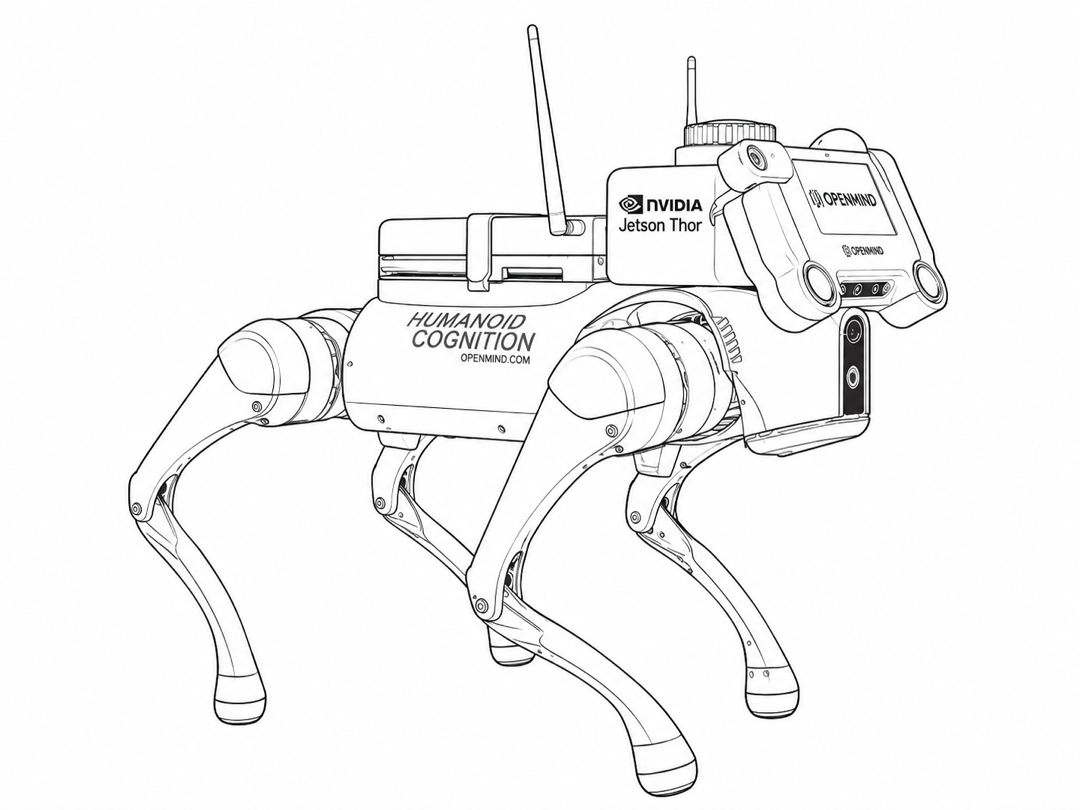
From research to real-world autonomy, the **OM1 BrainPack** is a plug-and-play module that brings full autonomy to your robots.
The BrainPack is designed to be mounted directly onto a robot to bring together mapping, object recognition, remote control, and self-charging capabilities — giving humanoids and quadrupeds what they need to navigate, remember, and act with purpose.
> The BrainPack makes your robot smarter — a system that **learns, moves, and builds with you.**
 ### Key Features
| Feature | Description |
| ------------------------- | ------------------------------------------------------------- |
| **NVIDIA Thor** | Provides powerful GPU compute for AI inference and navigation |
| **JetPack 7.0** | Latest NVIDIA software stack with optimized ML libraries |
| **ROS2 Support** | Compatible with current and future versions of ROS2 |
| **Robot Agnostic** | Control different robot form factors (quadrupeds, humanoids) |
| **Connectivity** | Ethernet, USB, and multiple power options |
| **Open Reference Design** | Build your own with published specifications |
### Hardware Specifications
Each BrainPack comes with:
* NVIDIA Thor compute module
* Integrated speakers for TTS output
* Multiple connectivity options (Ethernet, USB)
* Flexible power input options
* Mounting hardware for supported robots
### Supported Robots
| Robot | Support Level |
| --------------------- | ----------------- |
| Unitree Go2 | ✅ Fully Supported |
| Deep Robotics M20 Pro | ✅ Fully Supported |
| Unitree G1 | ✅ Fully Supported |
| LimX Tron | ✅ Fully Supported |
### Next Steps
The BrainPack is open-source and you can refer to the guidelines to build your own [here](https://github.com/OpenMind/brainpack).
---
# Agent Instructions
This documentation is published with GitBook. GitBook is the documentation platform designed so that both humans and AI agents can read, navigate, and reason over technical content effectively. Learn more at gitbook.com.
## Querying This Documentation
If you need additional information that is not directly available in this page, you can query the documentation dynamically by asking a question.
Perform an HTTP GET request on the current page URL with the `ask` query parameter, and the optional `goal` query parameter:
```
GET https://docs.openmind.com/full-autonomy-guidelines/brainpack_introduction.md?ask=&goal=
```
`ask` is the immediate question: it should be specific, self-contained, and written in natural language.
`goal` is optional and describes the broader end goal you are ultimately trying to accomplish on behalf of the user. GitBook uses it to tailor the answer towards what is most useful for that goal.
The response will contain a direct answer to the question and relevant excerpts and sources from the documentation.
Use this mechanism when the answer is not explicitly present in the current page, you need clarification or additional context, or you want to retrieve related documentation sections.
### Key Features
| Feature | Description |
| ------------------------- | ------------------------------------------------------------- |
| **NVIDIA Thor** | Provides powerful GPU compute for AI inference and navigation |
| **JetPack 7.0** | Latest NVIDIA software stack with optimized ML libraries |
| **ROS2 Support** | Compatible with current and future versions of ROS2 |
| **Robot Agnostic** | Control different robot form factors (quadrupeds, humanoids) |
| **Connectivity** | Ethernet, USB, and multiple power options |
| **Open Reference Design** | Build your own with published specifications |
### Hardware Specifications
Each BrainPack comes with:
* NVIDIA Thor compute module
* Integrated speakers for TTS output
* Multiple connectivity options (Ethernet, USB)
* Flexible power input options
* Mounting hardware for supported robots
### Supported Robots
| Robot | Support Level |
| --------------------- | ----------------- |
| Unitree Go2 | ✅ Fully Supported |
| Deep Robotics M20 Pro | ✅ Fully Supported |
| Unitree G1 | ✅ Fully Supported |
| LimX Tron | ✅ Fully Supported |
### Next Steps
The BrainPack is open-source and you can refer to the guidelines to build your own [here](https://github.com/OpenMind/brainpack).
---
# Agent Instructions
This documentation is published with GitBook. GitBook is the documentation platform designed so that both humans and AI agents can read, navigate, and reason over technical content effectively. Learn more at gitbook.com.
## Querying This Documentation
If you need additional information that is not directly available in this page, you can query the documentation dynamically by asking a question.
Perform an HTTP GET request on the current page URL with the `ask` query parameter, and the optional `goal` query parameter:
```
GET https://docs.openmind.com/full-autonomy-guidelines/brainpack_introduction.md?ask=&goal=
```
`ask` is the immediate question: it should be specific, self-contained, and written in natural language.
`goal` is optional and describes the broader end goal you are ultimately trying to accomplish on behalf of the user. GitBook uses it to tailor the answer towards what is most useful for that goal.
The response will contain a direct answer to the question and relevant excerpts and sources from the documentation.
Use this mechanism when the answer is not explicitly present in the current page, you need clarification or additional context, or you want to retrieve related documentation sections.